What Is a Hybrid Solar Energy System?
A hybrid solar energy system combines solar panels, battery storage and a connection to the public electricity grid. Unlike a conventional on-grid installation, a hybrid system can store surplus solar energy for later use and, when equipped with suitable backup functionality, continue supplying selected electrical loads during a power outage.
A hybrid solar energy system combines the advantages of a grid-connected solar installation with battery storage and intelligent energy management. Depending on the equipment and configuration, it can also provide electricity during a power outage.
In a conventional on-grid installation, solar electricity is consumed directly or exported to the public grid. When solar production is insufficient, electricity is imported from the network.
An off-grid installation operates independently of the public electricity network and must generate and store sufficient energy to meet its electricity requirements.
A hybrid system offers a third approach. Solar panels generate electricity, batteries store surplus energy, and the public grid remains available when additional electricity is needed.
Having designed, installed and operated both on-grid and off-grid solar systems in Norway, I find hybrid technology particularly interesting. My experience has demonstrated the strengths and limitations of both approaches, especially during the Norwegian winter.
Hybrid systems offer an opportunity to combine many of these advantages without accepting all the limitations of operating completely off-grid.
How Does a Hybrid Solar Energy System Work?
A typical hybrid system consists of solar panels, a hybrid inverter or inverter/charger system, battery storage, monitoring equipment and a connection to the public electricity grid.
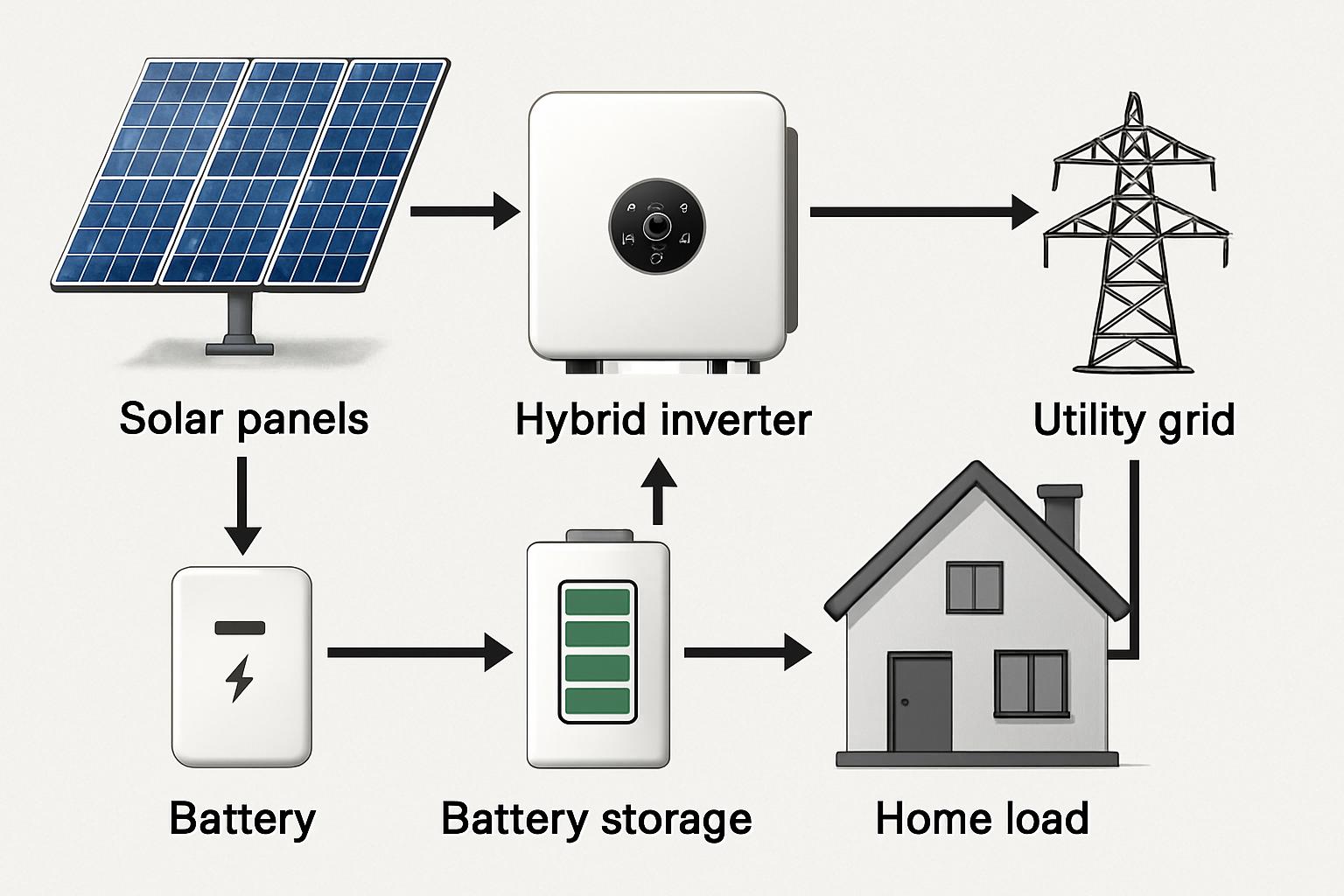
The system manages energy flow between these components according to electricity production, household demand, battery charge level and the operating settings selected by the owner.
During normal operation, the system may follow this sequence:
- Solar production: Solar panels generate electricity for household consumption.
- Battery charging: Surplus solar electricity charges the battery, according to the configured operating strategy.
- Grid export: Once household demand and charging requirements have been satisfied, remaining production may be exported to the public grid.
- Battery discharge: When solar production decreases, stored electricity can supply the property.
- Grid import: If solar and battery power are insufficient, electricity is imported from the public grid.
Some installations can also charge their batteries from the grid when electricity prices are low and discharge them when prices are higher.
The actual operating sequence depends on the inverter, battery management system, tariff arrangements and user-defined priorities.
Main Components of a Hybrid Installation
Solar Panels
Solar photovoltaic (PV) panels convert sunlight into direct current (DC).
The installed capacity is normally expressed in kilowatts-peak (kWp). Annual electricity production depends on geographical location, orientation, inclination, shading and local weather conditions.
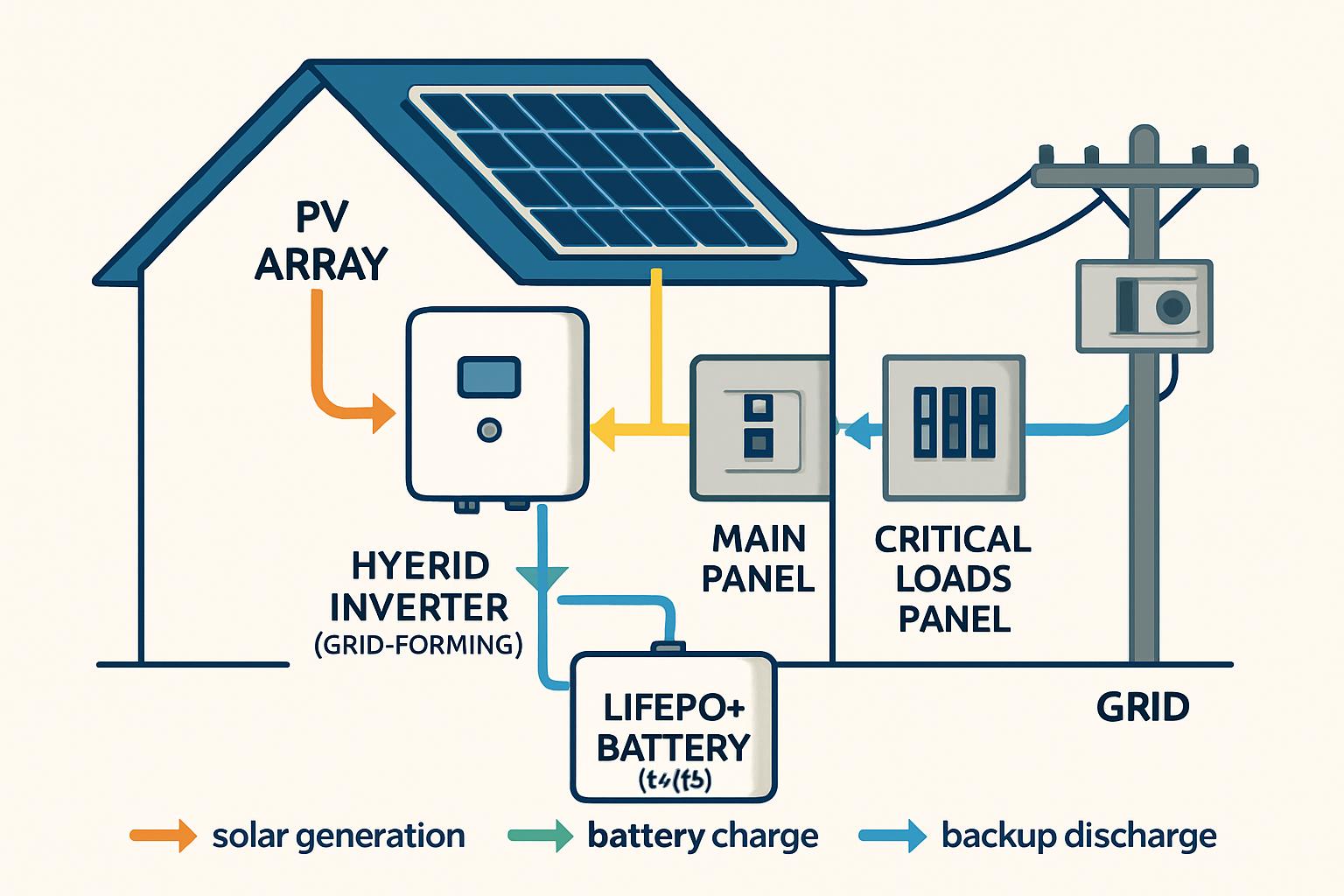
In Norway, seasonal differences are particularly important. During summer, long daylight hours can produce substantial amounts of electricity, while winter production can be considerably lower.
Hybrid Inverter
The hybrid inverter is one of the central components of the installation.
Depending on its design, it can manage solar generation, battery charging and discharging, grid import and export, and potentially backup electricity during grid outages.
Hybrid systems can use DC-coupled or AC-coupled configurations.
In a DC-coupled system, solar panels and batteries are integrated on the DC side of compatible conversion equipment. In an AC-coupled system, a separate battery inverter/charger can work alongside an existing grid-connected solar inverter.
This distinction becomes particularly important when adding battery storage to an existing solar installation.
Not every hybrid inverter provides backup power. Emergency Power Supply (EPS) or backup operation must be specifically supported by the equipment and electrical installation.
Victron Energy offers a wide range of inverters, battery chargers, solar charge controllers and monitoring solutions for off-grid and hybrid energy systems. For further information, visit the official Victron Energy website.
Battery Storage
The battery stores electricity for use when solar production is insufficient or when electricity purchased from the public grid would be more expensive.
Lithium iron phosphate (LiFePO₄) batteries are commonly used in residential energy storage because of their cycle life, efficiency and relatively low maintenance requirements.
A battery capacity of 10 kWh does not mean that 10 kW of power can be delivered continuously. Battery energy capacity (kWh) and maximum power output (kW) are different specifications.
The usable energy also depends on battery operating limits, temperature, reserve settings and the inverter’s efficiency.
Battery compatibility must always be confirmed with the inverter manufacturer.
Smart Metering and Monitoring
A hybrid installation requires suitable energy metering and monitoring equipment.
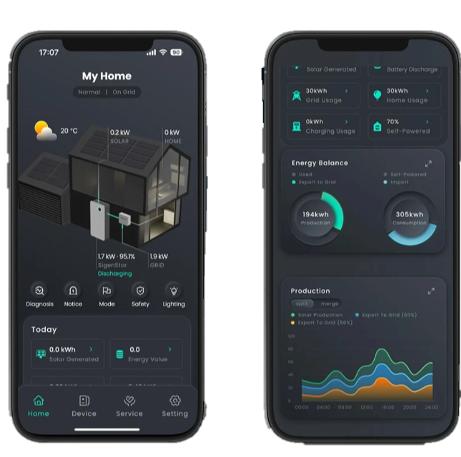
Modern systems can display:
- Solar electricity production.
- Household electricity consumption.
- Battery state of charge (SOC).
- Electricity imported from the public grid.
- Surplus electricity exported to the grid.
- Historical energy production and consumption.
Depending on the manufacturer, monitoring may also provide tariff scheduling, battery reserve settings, alarms and remote diagnostics.
Hybrid Solar Energy Systems During a Power Outage
One of the most important reasons for considering a hybrid system is energy security.
A conventional grid-connected solar inverter normally shuts down when the public electricity network fails. This is a safety requirement designed to prevent electricity from being supplied into a disconnected public network.
A hybrid installation can overcome this limitation, but only if it is designed for backup operation.
When a grid failure occurs, an appropriately configured hybrid system can disconnect safely from the public network and establish a local electricity supply.
Selected circuits may continue operating from the battery and, where supported, solar generation.
Typical essential loads include refrigeration, lighting, communications equipment, selected heating controls and other low-power equipment.
A correctly designed system may also support the entire property, although this requires sufficient inverter capacity, battery power and appropriate switching and protection equipment.
Important: A hybrid inverter and battery do not automatically guarantee electricity during a power outage. Backup capability depends on the complete installation, including isolation, earthing, protection, circuit allocation and inverter configuration.
How Long Can a Hybrid Battery Provide Electricity?
The duration of backup electricity depends primarily on usable battery capacity and the electrical load.
Consider a simplified example:
| Parameter | Value |
|---|---|
| Nominal battery capacity | 10 kWh |
| Assumed usable fraction | 90% |
| Available battery energy | 9 kWh |
| Average essential load | 500 W |
| Theoretical operating time | 18 hours |
This calculation assumes a constant load and excludes inverter conversion losses and additional standby consumption.
Actual backup duration may therefore be shorter.
If the average electricity demand increases to 1,000 W, the theoretical operating time falls to approximately nine hours.
This demonstrates why the selection of essential circuits is often more important than attempting to power every electrical appliance during an emergency.
Solar generation during an outage may extend the operating time, provided the inverter supports solar charging and generation while operating independently of the grid.
Hybrid Solar Energy Systems and Electricity Prices
Battery storage can improve the financial performance of a solar installation by increasing self-consumption.
Instead of exporting all surplus electricity during sunny periods, the household can store some of that energy for use in the evening or at night.
A hybrid system may also support time-of-use electricity tariffs.
For example, a battery could charge from the public grid during a low-price period and discharge during a higher-price period.
However, this does not automatically guarantee financial savings.
Battery charging and discharging involve energy losses. Battery cycling also contributes to long-term wear, and storing solar electricity can mean losing potential export revenue.
A realistic economic assessment must consider electricity tariffs, battery efficiency, export compensation, equipment cost and expected battery service life.
In Norway, the economics are also affected by network tariffs and the distinction between electricity imported from the grid and electricity exported to it.
For households in Great Britain, time-of-use tariffs and export arrangements such as the Smart Export Guarantee (SEG) may influence the calculation.
The best operating strategy will therefore depend on the country, electricity contract and consumption pattern.
Example: A Hybrid System for a Family Home
Consider a hypothetical grid-connected family home equipped with the following installation:
| Component | Example specification |
|---|---|
| Solar panel capacity | 6 kWp |
| Hybrid inverter | 5 kW |
| Battery capacity | 10 kWh |
| Grid connection | Public electricity network |
| Backup supply | Selected essential circuits |
| Monitoring | Solar, battery and grid energy flows |
During sunny periods, solar electricity supplies the household and charges the battery.
When the battery reaches the configured charging limit, surplus energy can be exported to the grid if the installation permits it.
In the evening, the battery can supply household electricity until it reaches its programmed minimum state of charge.
If the battery becomes depleted, electricity is imported from the public network.
During a grid failure, a correctly configured backup arrangement can continue supplying essential circuits for as long as sufficient energy and inverter capacity remain available.
This example illustrates the operating principles rather than representing a complete electrical design or a recommended system size.
My Experience with On-Grid and Off-Grid Systems
I currently operate two different types of solar installations in Norway.
My on-grid installation consists of 24 Jinko Solar panels with a combined installed capacity of 9.48 kWp, connected to a Solis 10 kW three-phase inverter.
It generates electricity for my grid-connected property, with surplus production exported to the public electricity network.
My off-grid property operates independently of the public grid. It uses several battery banks, solar charge controllers and inverters, including equipment from Victron Energy.
These installations have taught me important practical lessons.
With an on-grid installation, the public network provides electricity whenever solar production is insufficient. This simplifies everyday operation considerably.
With an off-grid installation, energy storage, battery state of charge, inverter capacity and available solar production become central to daily planning.
During winter, these differences are particularly noticeable.
A well-designed hybrid system can potentially reduce the amount of electricity purchased from the public grid while maintaining a reserve of stored energy for selected essential loads.
It cannot completely eliminate dependence on the public grid in every situation, but it can provide a useful compromise between energy independence, convenience and cost.
Advantages and Limitations of a Hybrid Solar Energy System
The principal advantages of a hybrid solar energy system include increased solar self-consumption, optional backup electricity, flexible battery management and opportunities to adapt electricity consumption to variable tariffs.
A hybrid solar energy system can also store surplus solar electricity for use during the evening or at night, reducing dependence on electricity purchased from the public grid.
However, these benefits must be balanced against higher installation costs, battery ageing, additional system complexity and the need for correctly designed electrical protection.
A hybrid installation is therefore not necessarily the best choice for every property.
Where backup electricity is unnecessary and the financial benefit of storage is limited, a conventional on-grid solar installation may be more economical.
Where no practical public grid connection exists, a fully off-grid system may be the only realistic solution.
Choosing the right hybrid solar energy system requires an assessment of electricity consumption, solar production, battery capacity, installation costs and the need for backup power.
Safety and Grid Connection Requirements
Hybrid solar systems combine several electrical energy sources and require careful design.
Electrical protection, inverter compatibility, battery management, grid isolation and backup operation must all be evaluated as part of the complete installation.
In Norway, installation work must comply with applicable electrical regulations and relevant NEK standards. Grid-connected equipment must also satisfy the requirements of the local distribution network operator.
In Great Britain, grid-connected generation and storage must be assessed under the applicable connection requirements, including Engineering Recommendations G98, G99 and, where relevant, G100.
Electrical installation requirements include BS 7671 and the applicable manufacturer instructions.
The exact requirements depend on the equipment, system capacity, connection arrangement and jurisdiction.
Hybrid Solar Systems – The Best of Both Worlds?
My experience with solar installations has convinced me that there is no single energy solution suitable for every property.
Off-grid systems offer independence but require sufficient energy production and storage.
On-grid systems offer simplicity and access to the public electricity network but normally cannot provide electricity during a grid failure.
Hybrid systems offer a third approach, combining grid-connected solar generation with energy storage and, when properly designed, backup capability.
For households interested in both reducing electricity costs and improving energy security, hybrid technology deserves serious consideration.
The decision should always be based on actual electricity consumption, available solar production, desired backup capability, investment costs and local regulations.
Further Reading – My Books on Solar Energy
The subjects discussed on this website are explored in greater technical and practical detail in my books on solar energy and energy systems.
Solenergi og energisystemer – En komplett guide til Off-Grid, On-Grid og Hybridanlegg
My Norwegian-language book covers solar panels, batteries, inverters, electrical installations, energy management, off-grid operation, grid-connected systems, hybrid solutions and energy preparedness.
Published in October 2026, it combines technical explanations with practical experience from my own installations in Norway.
Read more about the Norwegian book
Solar Energy and Energy Systems – English Edition
My forthcoming English-language book expands the material for an international readership, with particular attention to Great Britain.
Chapter 13, Hybrid Systems – The Best of Both Worlds?, examines system architecture, battery storage, backup operation, time-of-use control, system sizing, monitoring and practical examples.
The English edition is currently in preparation.
For additional information about my own installations, see the Off-Grid and On-Grid sections of this website.