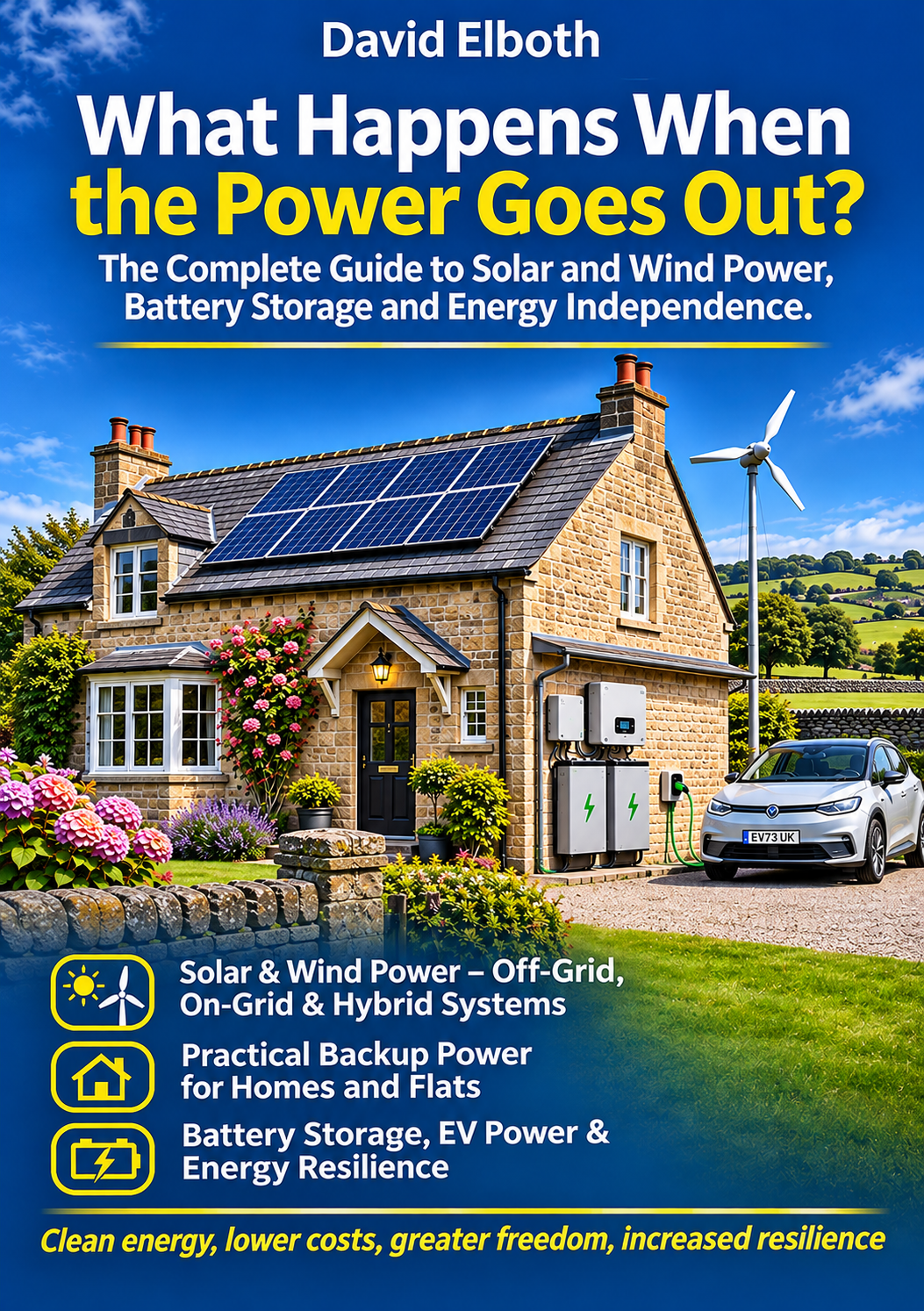
A Complete Guide to Off-Grid, On-Grid and Hybrid Systems
By David Elboth
New English-language edition – planned publication in 2027
“What Happens When the Power Goes Out?” is an expanded, practical guide to solar power, battery storage, wind energy, electrical safety and energy resilience, written specifically for the UK market.
Publication status: In preparation.
What Happens When the Power Goes Out?
Solar energy and energy systems are becoming increasingly important for energy security and independence. We often take a reliable electricity supply for granted. But what happens when the power grid fails? How vulnerable is our electricity infrastructure to extreme weather, technical failures, cyberattacks or major disruptions? And how can we produce, store and manage electricity ourselves?
“What Happens When the Power Goes Out?” is a comprehensive and accessible technical book for anyone who wants to understand how modern solar power installations and energy systems work.
This English-language edition is substantially expanded and specifically adapted to the United Kingdom. It builds on the Norwegian edition published in October 2026, but includes additional chapters, technical material, practical examples and calculations relevant to British conditions.
Developed for UK Electrical Systems and Standards
The book has been adapted to the electrical systems, installation practices and regulatory requirements used in the United Kingdom.
It addresses both DC (direct current) and AC (alternating current) systems, including electrical protection, earthing arrangements, cable sizing, battery installations, inverters and connections to the public electricity network.
Particular attention is given to BS 7671 (the IET Wiring Regulations) and the relevant UK requirements for connecting electricity generation and energy storage systems to distribution networks, including G98, G99 and G100. For further information about British electrical standards, visit the Institution of Engineering and Technology (IET).
The technical explanations and practical examples reflect British electrical infrastructure and installation requirements, while also highlighting important differences between the UK and Norway.
An Expanded Review of Manufacturers and Equipment
The English edition includes a substantially expanded overview of manufacturers and suppliers, with particular emphasis on equipment and technologies available in the UK market.
The book examines manufacturers such as Victron Energy, Solis, Fox ESS, Sunsynk, SolaX Power, Sigenergy, Tesla Energy, Renogy and other important suppliers of solar panels, inverters, battery systems and associated equipment.
Rather than simply listing manufacturers, it discusses their different system approaches, product categories, technical characteristics, compatibility, support and suitability for different installations.
The aim is to help readers understand the alternatives available when selecting equipment for an off-grid, on-grid or hybrid energy system.
Technical and Financial Comparisons Between the UK and Norway
An important feature of this edition is the inclusion of technical and financial comparisons between solar energy installations in the United Kingdom and Norway.
These comparisons examine differences in solar irradiation, seasonal electricity production, climate, electrical infrastructure, installation requirements and system performance.
The book also includes financial calculations comparing grid-connected solar installations, including a 10 kWp system in Norway and a comparable installation in Scotland.
The examples consider electricity generation, self-consumption, electricity import costs, export payments, investment costs and the financial implications of operating solar installations under different national conditions.
By combining technical analysis with economic calculations, the book provides a broader basis for understanding both the practical possibilities and the financial limitations of solar energy systems.
Energy Security, Power Grid Failures and Wind Energy
Solar power is not simply about reducing electricity bills. Energy security and resilience are equally important.
The English edition includes a dedicated chapter examining what can bring down the electricity network, covering extreme weather, solar storms, cyber threats, technical failures, electricity shortages and the consequences of prolonged power cuts.
Another important addition is a separate chapter on wind power, explaining how wind turbines generate electricity, why location and wind conditions are critical, and how wind and solar energy can complement one another.
This is particularly relevant in parts of the United Kingdom where seasonal solar production is limited but suitable wind resources may be available.
From Theory to Practical Experience
The book covers solar energy and energy systems in practice, from solar panels, charge controllers and battery banks to inverters, system sizing, electrical protection, monitoring, operation and maintenance.
Its technical explanations are supported by practical experience from the author’s own off-grid and grid-connected installations in Norway.
The objective is to give readers the knowledge needed to understand, evaluate and plan reliable energy systems, while recognising the importance of safety, professional competence, regulations and sound financial decisions.
What Will You Learn About Solar Energy and Energy Systems?
- How solar panels convert sunlight into electrical energy.
- The differences between off-grid, on-grid and hybrid installations.
- What can cause electricity network failures and how households can improve their resilience.
- How battery banks work and which battery technologies are suitable for different applications.
- How to select and use charge controllers, inverters and other essential components.
- How to calculate electricity consumption and size a solar power installation.
- How wind turbines generate electricity and when wind power can complement solar energy.
- How to combine solar panels, battery storage, wind power and backup generators.
- How UK weather conditions affect electricity generation.
- How UK electrical standards and installation requirements apply to DC and AC solar energy systems, including BS 7671 and the G98, G99 and G100 requirements.
- How major manufacturers and suppliers serving the UK market differ in equipment, system architecture, compatibility and technical capabilities.
- How solar installations in the UK and Norway compare technically and financially, including electricity generation, investment costs, self-consumption, import costs and export payments.
- What you need to know about electrical safety, installation, monitoring and maintenance.
- How to evaluate the costs, savings and practical benefits of grid-connected solar installations.
- How alternative electricity supplies can improve household preparedness during power interruptions.
- Which technological developments may influence future energy systems.
The book includes technical illustrations, practical examples, calculations, tables and explanations that help readers understand how the different components work together.
Who Is This Book For?
“What Happens When the Power Goes Out?” is written for beginners, technically interested readers and professionals who want a deeper understanding of modern solar installations and energy systems.
The book is particularly relevant to:
- Homeowners considering solar panels, battery storage or hybrid energy systems.
- Owners of cottages and remote properties who want an independent electricity supply or greater energy security.
- Property managers and housing organisations considering shared solar installations or energy storage.
- Electricians and electrical installers who want to develop their understanding of solar power, battery systems and hybrid installations.
- Solar panel installers, roofers, carpenters and building contractors involved in installing solar equipment and associated mounting systems.
- Engineers, technicians and energy consultants seeking a broader understanding of complete energy systems.
- Students and apprentices studying electrical engineering, renewable energy, construction or related technical subjects.
- Technically interested readers who want to understand electricity, batteries, inverters, charge controllers and energy management.
- People concerned with emergency preparedness and energy resilience who want to understand alternative electricity supplies.
- Anyone considering a solar or hybrid installation who wants to make informed technical and financial decisions.
The book combines fundamental theory about solar energy and energy systems with practical examples, illustrations, calculations and technical explanations.
Its purpose is to provide readers with a sound foundation for understanding, planning and evaluating different energy solutions, whether for a private home, a remote cottage or a professional installation project.
The book is an educational and technical resource. It does not replace the qualifications, professional assessments, manufacturers’ instructions or regulatory requirements applicable to electrical installations.
About the Author
David Elboth has an academic background in astrophysics, specialising in stellar models. He also has extensive experience in information technology, software development and programming, including Java, Kotlin and Python.
As a British and Norwegian citizen with Scottish family roots, he has a particular interest in how energy systems perform under northern European conditions.
Over many years, he has designed, built, operated and modified several off-grid energy installations, together with a grid-connected solar power system in Norway.
His practical experience includes solar panels, charge controllers, inverters, lead-acid and lithium batteries, electrical distribution, monitoring and energy management.
He has also developed his own Python software for collecting and analysing data from Victron Energy systems, alongside software for monitoring and comparing energy production and consumption.
In this book, he combines scientific understanding, technical knowledge and extensive practical experience.
His objective is to make solar energy and modern energy systems understandable to a broad readership, while providing sufficient technical depth for readers who want to explore the subject further.
Publication and Availability
“What Happens When the Power Goes Out?” – David Elboth
Planned publication: 2027
The English-language edition is currently being prepared, with particular attention to readers in the United Kingdom.
It is a substantially expanded and adapted edition of the Norwegian book Solenergi og energisystemer, published in October 2026.
The English edition includes additional material covering UK electrical regulations, electricity network requirements, wind power, energy resilience, an expanded review of manufacturers serving the UK market, and technical and financial comparisons between British and Norwegian conditions.
The final publication date, ISBN, retail price and distribution arrangements will be announced when confirmed.
The intention is to make the book available through bookshops and online retailers, particularly in the United Kingdom.
Norwegian Edition – Available Now
The Norwegian edition, Solenergi og energisystemer – En komplett guide til Off-Grid, On-Grid og Hybridanlegg, was published in October 2026.
It contains 392 pages and is available directly from the author and through bookshop distribution.
Read more about the Norwegian edition
Book Information
| Book Information | |
|---|---|
| Title | Solar Energy and Energy Systems |
| Subtitle | A Complete Guide to Off-Grid, On-Grid and Hybrid Systems |
| Author | David Elboth |
| Language | British English |
| Edition | Expanded English-language edition |
| Publication | Planned for 2027 |
| Length | Approximately 590 pages, subject to final layout |
| ISBN | To be announced |
| Price | To be announced |
| Availability | UK and international book distribution planned |
Contents – The Book’s 21 Chapters
The book takes readers from basic electrical principles and solar energy to system sizing, electrical safety, practical installations and future technologies.
A particular feature of the English edition is its emphasis on electricity network resilience, wind energy, British electrical standards, manufacturers serving the UK market and technical and financial comparisons between the United Kingdom and Norway.
- Introduction – Why Off-Grid or On-Grid?
- What Can Bring Down the Power Grid?
- Basic Principles of Electricity
- Energy Needs – How Much Electricity Do I Need?
- Solar Panels – The Heart of the System
- Charge Controllers – Battery Charging
- Battery Banks – The Heart of Energy Storage
- Inverters – From DC to AC
- Other Important Components
- On-Grid – Solar Power Connected to the Grid
- Off-Grid – Complete Independence
- Wind Power – A Complement to Solar Energy
- Hybrid Systems – The Best of Both Worlds?
- Which System Is Right for You?
- Important Manufacturers
- Step by Step – The Author’s Own Projects
- Frost in an Off-Grid System
- UK Conditions, Standards and Safety
- Operation, Maintenance and Troubleshooting
- Future Energy Systems
- Conclusion and Further Resources
The complete table of contents, including all sections and subsections, will be presented below.
Complete Table of Contents
CHAPTER 1: INTRODUCTION – WHY OFF-GRID OR ON-GRID?
- 1.1 The energy future and solar power
- 1.1.1 The rapid growth of solar power
- 1.1.2 Why choose solar power?
- 1.2 The Sun as an energy source – from fusion to photons
- 1.2.1 What is the Sun?
- 1.2.2 From the Sun to Earth – photons on a journey
- 1.2.3 Light waves and the spectrum
- 1.2.4 How much energy reaches the Earth?
- 1.3 Definitions – off-grid, on-grid and hybrid
- 1.3.1 On-grid (grid-connected system)
- 1.3.2 Off-grid (stand-alone system)
- 1.3.3 Hybrid system
- 1.4 Different applications
- 1.5 Comparing the system types
- 1.6 Off-grid as a resilience solution
- 1.6.1 Solar storms and the Kp index
- 1.7 Chapter 1 summary
CHAPTER 2: WHAT CAN BRING DOWN THE POWER GRID?
- 2.1 Introduction – How vulnerable is the power grid?
- 2.2 Solar storms and geomagnetic disturbances
- 2.2.1 From the Sun to the electricity network
- 2.2.2 The Kp index and the British warning system
- 2.2.3 Historical lessons – and a personal perspective
- 2.3 Extreme weather – storms, floods, snow and ice
- 2.3.1 Why weather is such a practical UK risk
- 2.3.2 UK case study – Storm Arwen, November 2021
- 2.3.3 The consequences inside a home
- 2.4 Cyberattacks, sabotage and terrorism
- 2.5 War and armed conflict
- 2.6 Fuel shortages and supply chain disruptions
- 2.7 Technical failures and cascading blackouts
- 2.7.1 What is a cascading failure?
- 2.7.2 UK case study – 9 August 20
- 2.7.3 Restoring a badly disrupted system
- 2.8 The Atlantic Ocean Circulation and the UK Power Grid
- 2.8.1 A personal perspective on climate modelling
- 2.8.2 The Gulf Stream and AMOC
- 2.8.3 Observations and scientific uncertainty
- 2.8.4 Possible consequences for the United Kingdom
- 2.8.5 Risks to electricity infrastructure
- 2.8.6 Energy resilience and preparedness
- 2.9 Electricity generation shortages and grid instability
- 2.10 How long could a major blackout last?
- 2.11 How off-grid and hybrid systems can improve resilience
- 2.12 Chapter 2 summary
CHAPTER 3: BASIC PRINCIPLES OF ELECTRICITY
- 3.1 What Is Electric Current?
- 3.2 The Four Basic Electrical Quantities
- 3.2.1 Voltage – Measured in Volts (V)
- 3.2.2 Current – Measured in Amperes (A)
- 3.2.3 Resistance – Measured in Ohms (Ω)
- 3.2.4 Power – Measured in Watts (W)
- 3.3 Energy – Kilowatt-hours (kWh)
- 3.4 Direct Current (DC) vs Alternating Current (AC)
- 3.4.1 Direct Current (DC)
- 3.4.2 Alternating Current (AC)
- 3.4.3 What Does This Mean for Your Solar Energy System?
- 3.5 Ohm’s Law – The Golden Rule
- 3.6 Important Formulae – Your Checklist
- 3.6.1 Power Formula
- 3.6.2 Energy Formula
- 3.6.3 Ohm’s Law
- 3.6.4 Power Loss in Cables
- 3.7 Calculating Electricity Consumption – Practical Examples
- 3.8 Voltage in Solar Power Systems – Two Different Worlds
- 3.8.1 Battery System Voltage
- 3.8.2 Array Voltage (from the Solar Panels)
- 3.8.3 The AC Side (230 V – What You Use in the Home)
- 3.8.4 Summary – Voltages in the System
- 3.8.5 Safety – Two Different Hazards
- 3.9 Cables – Fixed and Flexible Applications
- 3.9.1 Cable Types – Fixed and Flexible Applications
- 3.9.2 Why Use PV Cable for Solar Panels?
- 3.9.3 Current-Carrying Capacity of 6 mm²
- 3.10 Common Misunderstandings – and the Correct Explanation
- 3.11 Chapter 3 summary
CHAPTER 4: ENERGY NEEDS – “HOW MUCH ELECTRICITY DO I NEED?”
- 4.1 Why this matters for both types of system
- 4.1.1 For off-grid systems: Precision is essential
- 4.1.2 For on-grid systems: Economic optimisation
- 4.1.3 A common starting point
- 4.2 Step-by-step guide to calculating your electricity consumption
- 4.2.1 Step 1: Collect the data
- 4.2.2 Step 2: Find the power rating of each appliance
- 4.2.3 Step 3: Calculate daily energy consumption
- 4.2.4 Step 4: Add up the daily consumption
- 4.2.5 Step 5: Calculate annual consumption
- 4.3 Seasonal variations – UK conditions
- 4.3.1 Solar resource through the year
- 4.3.2 Heating – the elephant in the room
- 4.4 Creating a power and consumption list
- 4.4.1 Example A: Off-grid cottage (50 m²)
- 4.4.2 Example B: On-grid detached house (150 m²)
- 4.5 Sizing an off-grid system in the UK – a location-based method
- 4.5.1 Why does the old formula fail?
- 4.5.2 A better method – size for location and season
- 4.5.3 What does this mean in practice?
- 4.5.4 Practical recommendation for off-grid systems in the UK
- 4.6 Emergency sizing – minimum consumption
- 4.6.1 What is “minimum consumption”?
- 4.6.2 How long must the system last?
- 4.6.3 Sizing the PV array for emergency use
- 4.7 Tools that simplify the calculations
- 4.7.1 Smart meter data
- 4.7.2 Plug-in energy meter
- 4.7.3 Energy supplier app or online account
- 4.7.4 Spreadsheet (Excel/Google Sheets)
- 4.7.5 Online calculators
- 4.7.6 PVGIS – for location-specific data
- 4.8 Common mistakes and pitfalls
- 4.9 Chapter 4 summary
CHAPTER 5: SOLAR PANELS – THE HEART OF THE SYSTEM
- 5.1 From silicon to electricity – the photovoltaic effect
- 5.1.1 What is a semiconductor?
- 5.1.2 How does a solar cell work?
- 5.1.3 Photons strike – electrons start moving
- 5.1.4 From a single cell to a panel
- 5.2 Monocrystalline vs polycrystalline
- 5.2.1 Today’s market (2027)
- 5.2.2 What is TOPCon?
- 5.2.3 What is HJT?
- 5.2.4 What is Back Contact (BC/IBC/ABC/HPBC)?
- 5.2.5 What is perovskite–silicon tandem?
- 5.2.6 What should you choose today?
- 5.2.7 Thin-film and flexible solar panels – special applications
- 5.3 What are Wp (watt-peak) and efficiency?
- 5.3.1 Wp – watt-peak (maximum rated power)
- 5.3.2 Efficiency
- 5.4 Tilt, orientation, shading and installation
- 5.4.1 Orientation – which way should the panels face?
- 5.4.2 Tilt – the angle of the panels
- 5.4.3 Shading – your biggest enemy
- 5.5 Installing solar panels
- 5.5.1 Before you begin – roof assessment and safety
- 5.5.2 Choosing a mounting system – matched to the roof type
- 5.5.3 Installation on a pitched roof – the most common solution
- 5.5.4 Installation on a flat roof – different challenges
- 5.5.5 Ground mounting – an alternative to the roof
- 5.5.6 UK considerations – wind, rain, snow and coastal exposure
- 5.5.7 Installation checklist
- 5.6 Series vs parallel connection
- 5.6.1 Series connection (‘string’)
- 5.6.2 Parallel connection
- 5.6.3 Which should you choose?
- 5.7 How to choose panels – a practical guide
- 5.7.1 Energy and power requirements (from Chapter 4)
- 5.7.2 How much space do you have?
- 5.7.3 What is your budget?
- 5.7.4 Which technology should you choose?
- 5.7.5 Which manufacturer should you choose?
- 5.7.6 Check certification and suitability
- 5.7.7 What is the price per Wp?
- 5.8 Common questions about solar panels
- 5.8.1 How long does a solar panel last?
- 5.8.2 What happens as the panel ages?
- 5.8.3 Can I walk on solar panels?
- 5.8.4 Can they withstand hail?
- 5.8.5 Can they generate electricity from moonlight?
- 5.9 How far have we come with efficiency?
- 5.9.1 Future technology
- 5.10 Chapter 5 summary
CHAPTER 6: CHARGE CONTROLLERS – BATTERY CHARGING
- 6.1 What is a charge controller – and why do you need one?
- 6.1.1 What happens without a charge controller?
- 6.2 The two main types: PWM vs MPPT
- 6.2.1 PWM – Pulse Width Modulation
- 6.2.2 MPPT – Maximum Power Point Tracking
- 6.2.3 PWM vs MPPT – which should you choose?
- 6.3 How to choose the correct size (amps)
- 6.4 Overvoltage protection and fusing
- 6.4.1 Protection between the panels and controller
- 6.4.2 Protection between controller and battery
- 6.4.3 Surge protective devices (SPDs)
- 6.5 Temperature compensation – important in a variable climate
- 6.6 Monitoring and software
- 6.6.1 Victron Energy – VRM Portal
- 6.6.2 Solis – SolisCloud
- 6.6.3 EPEVER – Monitoring and communication
- 6.6.4 Morningstar – LiveView and MSView
- 6.6.5 Renogy – DC Home and Renogy ONE
- 6.6.6 Why is monitoring useful?
- 6.7 Frequently asked questions about charge controllers
- 6.7.1 Do I need a charge controller in an on-grid system?
- 6.7.2 Can I connect two MPPT controllers to the same battery?
- 6.7.3 What happens if the controller becomes too hot?
- 6.7.4 Using MPPT controller with lead-acid/lithium batteries?
- 6.7.5 Why are adequately sized cables important?
- 6.8 Major manufacturers – a brief overview
- 6.8.1 Victron Energy – widely used in off-grid systems
- 6.8.2 EPEVER – lower-cost alternative
- 6.8.3 Morningstar – established US manufacturer
- 6.8.4 Renogy – strong presence in the UK off-grid market
- 6.9 Chapter 6 summary
CHAPTER 7: BATTERY BANKS – THE HEART OF ENERGY STORAGE
- 7.1 Why batteries – and what do they actually do?
- 7.1.1 The main functions of a battery in a solar energy system
- 7.1.2 Battery chemistry – a simple explanation
- 7.2 The main battery types – an overview
- 7.2.1 Lead-acid batteries (AGM, gel and flooded)
- 7.2.2 Lithium batteries – LiFePO₄ (LFP)
- 7.2.3 Sodium-ion batteries
- 7.2.4 Other battery chemistries – a short comparison
- 7.3 Capacity, depth of discharge and cycles
- 7.3.1 Capacity (Ah – ampere-hours)
- 7.3.2 Depth of discharge (DoD)
- 7.3.3 Cycle life (number of cycles)
- 7.4 Series, parallel and series-parallel battery banks
- 7.4.1 Series connection – increasing the voltage
- 7.4.2 Parallel connection – increasing capacity
- 7.4.3 Combining series and parallel connections
- 7.4.4 The problem of imbalance in a series-connected bank
- 7.4.5 Battery balancers and midpoint monitoring
- 7.4.6 Important restrictions for lithium batteries
- 7.5 Sizing the battery bank
- 7.6 Safety, installation and maintenance
- 7.6.1 General safety
- 7.6.2 Specific points for lead-acid batteries
- 7.6.3 Specific points for lithium batteries (LiFePO₄)
- 7.6.4 Lithium-battery fire – what should you do?
- 7.6.5 Installation
- 7.6.6 Maintenance
- 7.7 Common questions about batteries
- 7.7.1 Can I mix old and new batteries?
- 7.7.2 Can I connect batteries in series and parallel?
- 7.7.3 How long do batteries last?
- 7.7.4 How much do batteries cost?
- 7.8 Which battery type should you choose?
- 7.9 Chapter 7 summary
CHAPTER 8: INVERTERS – FROM DC TO AC
- 8.1 What is an inverter – and why do you need one?
- 8.1.1 What does an inverter do besides converting electricity?
- 8.2 Pure sine wave vs modified sine wave – a critical difference
- 8.2.1 Pure sine wave
- 8.2.2 Modified sine wave / quasi-sine
- 8.3 How to size an inverter
- 8.4 Important features to look for
- 8.4.1 Automatic transfer switching
- 8.4.2 Low-voltage cut-off
- 8.4.3 Overcurrent and overload protection
- 8.4.4 Thermal protection
- 8.4.5 Power-saving / eco mode
- 8.4.6 Remote control
- 8.4.7 Monitoring and communications
- 8.5 Two main inverter categories – stand-alone and hybrid
- 8.5.1 Stand-alone inverter
- 8.5.2 Hybrid / multi-mode / grid-interactive inverter
- 8.6 Practical examples – sizing in practice
- 8.6.1 Example A: Off-grid cottage
- 8.6.2 Example B: Grid-connected home with battery storage
- 8.7 Cabling and connection – important considerations
- 8.7.1 Cable size from battery to inverter
- 8.7.2 Fuse between battery and inverter
- 8.7.3 RCD and protective devices on the AC side
- 8.8 Common questions about inverters
- 8.8.1 How much electricity does the inverter use itself?
- 8.8.2 Can I connect two inverters in parallel?
- 8.8.3 Inverter/charge controller from different manufacturers?
- 8.8.4 Can I connect a generator to the inverter?
- 8.8.5 What are surge capacity and peak power?
- 8.9 Major manufacturers
- 8.9.1 Victron Energy (Netherlands)
- 8.9.2 Solis
- 8.9.3 SMA (Germany)
- 8.9.4 Fronius (Austria)
- 8.9.5 SolarEdge
- 8.9.6 Enphase
- 8.9.7 Fox ESS
- 8.9.8 Sunsynk
- 8.9.9 Tesla Energy
- 8.9.10 GivEnergy
- 8.9.11 Renogy
- 8.9.12 Other major manufacturers
- 8.10 Chapter 8 summary
CHAPTER 9: OTHER IMPORTANT COMPONENTS
- 9.1 Fuses and overcurrent protection
- 9.1.1 What is a fuse, and how does it work?
- 9.1.2 Where is overcurrent protection required?
- 9.1.3 Example calculation
- 9.1.4 Heat and power loss in fuses and connections
- 9.1.5 The protective device must protect the cable
- 9.2 Arc-fault protection
- 9.3 RCD selection and DC residual currents
- 9.4 Power factor – cos(φ)
- 9.5 Switches, isolators and distribution enclosures
- 9.5.1 DC isolators and switches
- 9.5.2 Main battery isolator
- 9.5.3 Distribution enclosures
- 9.5.4 Residual current devices (RCDs)
- 9.6 Cabling – the system’s arteries
- 9.6.1 Cable size – why does it matter?
- 9.6.2 Practical cable-sizing recommendations
- 9.6.3 Cable types
- 9.6.4 Cabling rules – remember these
- 9.7 Measuring instruments – monitor the health of the system
- 9.7.1 Multimeter – an essential tool
- 9.7.2 Clamp meter
- 9.7.3 Battery monitor / shunt
- 9.7.4 Panel voltmeter
- 9.8 Monitoring systems
- 9.8.1 Victron Energy – VRM Portal
- 9.8.2 Solis – SolisCloud
- 9.8.3 GivEnergy – App and Monitoring Portal
- 9.8.4 Renogy – DC Home and Renogy ONE
- 9.8.5 Why monitoring matters
- 9.9 Other useful components
- 9.9.1 DC/DC converters
- 9.9.2 DC outlets
- 9.9.3 USB power supplies
- 9.9.4 Earthing and bonding
- 9.10 Chapter 9 summary
CHAPTER 10: ON-GRID – SOLAR POWER CONNECTED TO THE GRID
- 10.1 What is an on-grid system?
- 10.1.1 How does it work in practice?
- 10.1.2 What distinguishes on-grid from off-grid?
- 10.2 Advantages and disadvantages of on-grid systems
- 10.2.1 Advantages
- 10.2.2 Disadvantages
- 10.3 System architecture and components
- 10.3.1 Solar PV modules
- 10.3.2 Grid-connected inverter
- 10.3.3 Import/export meter and smart meter
- 10.3.4 DC isolation and overcurrent protection
- 10.3.5 AC isolation and protection
- 10.3.6 Monitoring system
- 10.3.7 Plug-in and balcony PV systems
- 10.4 Connecting to the electricity network – what is required?
- 10.4.1 DNO notification or application
- 10.4.2 Do you need a generation licence?
- 10.4.3 Planning permission and building requirements
- 10.5 Export payments, certification and incentives
- 10.5.1 Smart Export Guarantee (SEG)
- 10.5.2 Self-consumption and export
- 10.5.3 VAT and other support
- 10.6 Economics and payback
- 10.6.1 What does an on-grid system cost?
- 10.6.2 How much electricity will the system generate?
- 10.6.3 How much can you save?
- 10.6.4 A financial comparison: S10 kWp solar PV installation
- 10.7 Monitoring and control
- 10.8 Frequently asked questions about on-grid systems
- 10.8.1 Does the system work during a power cut?
- 10.8.2 Do I need a battery?
- 10.8.3 Can I expand the system later?
- 10.8.4 What happens to surplus electricity in summer?
- 10.8.5 Do I pay tax on export income?
- 10.8.6 How does solar PV affect property value?
- 10.9 Chapter 10 summary
CHAPTER 11: OFF-GRID – COMPLETE INDEPENDENCE
- 11.1 What is an off-grid system?
- 11.1.1 How does it work in practice?
- 11.1.2 What distinguishes off-grid from on-grid?
- 11.2 When is off-grid appropriate?
- 11.2.1 Cabins and remote properties without a grid connection
- 11.2.2 Homes in remote areas
- 11.2.3 Resilience and self-sufficiency
- 11.2.4 Boats and motorhomes
- 11.2.5 Microgrids and communities
- 11.3 Complete system – from sunlight to socket
- 11.3.1 Solar panels
- 11.3.2 Charge controller (MPPT)
- 11.3.3 Battery bank
- 11.3.4 Inverter
- 11.3.5 Generator – a reserve source for off-grid systems
- 11.3.6 Portable power stations
- 11.3.7 The electric vehicle as an energy reserve
- 11.3.8 DC/DC converters (optional)
- 11.3.9 Fuses, isolators and distribution equipment
- 11.3.10 Monitoring
- 11.4 Sizing – the key to success
- 11.4.1 Why does the old rule fail at northern latitudes?
- 11.4.2 A better method – assess the weakest production period
- 11.4.3 What does this mean in practice?
- 11.4.4 Practical recommendation for northern off-grid systems
- 11.5 Advantages and disadvantages of off-grid
- 11.5.1 Advantages
- 11.5.2 Disadvantages
- 11.6 Living off-grid – everyday challenges and rewards
- 11.6.1 Energy awareness
- 11.6.2 An energy-efficient lifestyle
- 11.6.3 Monitoring is essential
- 11.6.4 The generator – the last line of reserve
- 11.6.5 The satisfaction of independence
- 11.6.6 How Much Comfort from Your Off-Grid System?
- 11.6.7 Practical Skills and Self-Reliance in Off-Grid Living
- 11.7 Practical advice for off-grid projects
- 11.7.1 Reduce demand first
- 11.7.2 Design for difficult periods – but remain realistic
- 11.7.3 Be realistic about the budget
- 11.7.4 Choose reliable components
- 11.7.5 Plan for future expansion
- 11.7.6 Prepare for Off-Grid Living – Not Just the Installation
- 11.8 Earthing arrangements and EV charging in off-grid systems
- 11.8.1 What happens in a stand-alone installation?
- 11.8.2 EV charging off-grid
- 11.9 Off-grid – an example of a complete system
- 11.10 Off-grid as a resilience solution
- 11.10.1 Sizing for resilience
- 11.10.2 What are “critical loads”?
- 11.10.3 Resilience sizing – example
- 11.10.4 Communications when mobile networks fail
- 11.11 Chapter 11 summary
CHAPTER 12: WIND POWER – A COMPLEMENT TO SOLAR ENERGY
- 12.1 Introduction – why consider wind power?
- 12.2 Wind power in the UK – England and Scotland
- 12.3 How wind turbines generate electricity
- 12.4 Wind speed, available power and energy production
- 12.4.1 How much energy is in the wind?
- 12.4.2 Cut-in speed is not the same as useful production
- 12.5 Choosing a suitable location
- 12.5.1 Why wind power often performs poorly in woodland
- 12.6 My experience with wind power in Nittedal
- 12.7 Small wind turbines for off-grid systems
- 12.7.1 Where can small-scale wind be useful?
- 12.7.2 Measure before you buy
- 12.8 Integrating wind with solar panels and batteries
- 12.9 Planning, regulations and safety
- 12.9.1 Planning and electrical connection
- 12.10 Wind power versus additional solar panels
- 12.10.1 Wind or more solar panels?
- 12.11 Chapter 12 Summary
CHAPTER 13: HYBRID SYSTEMS – THE BEST OF BOTH WORLDS?
- 13.1 What is a Hybrid System?
- 13.2 Components of a Hybrid System
- 13.2.1 Solar PV modules
- 13.2.2 Hybrid inverter – the central component
- 13.2.3 Battery bank
- 13.2.4 Smart meter and import/export metering
- 13.2.5 Monitoring system
- 13.2.6 Generator – optional, but useful for resilience
- 13.3 Advantages of Hybrid Systems
- 13.3.1 Increased self-consumption
- 13.3.2 Power during a grid outage
- 13.3.3 Time-of-use control and peak shaving
- 13.3.4 Future flexibility
- 13.3.5 Easier energy security than full off-grid operation
- 13.4 Disadvantages of Hybrid Systems
- 13.4.1 Higher initial cost than conventional on-grid PV
- 13.4.2 Batteries have a finite service life
- 13.4.3 Complexity
- 13.4.4 Not complete independence
- 13.5 Sizing a Hybrid System
- 13.6 Hybrid Systems in Practice – Examples
- 13.6.1 Example A: UK home, 6 kWp PV, 10 kWh battery
- 13.6.2 Example B: Larger UK home, 10 kWp PV, 20 kWh battery
- 13.6.3 Time-of-use control – a simple calculation
- 13.7 Hybrid Operation During a Grid Outage
- 13.7.1 Normal operation – grid available
- 13.7.2 Grid outage – backup/island mode
- 13.7.3 What if the battery becomes empty during an outage?
- 13.7.4 How long will the battery last?
- 13.8 Time-of-Use Control – Optimising Energy Costs
- 13.8.1 How does it work?
- 13.8.2 What do you need?
- 13.8.3 Is it financially worthwhile?
- 13.8.4 What are the limitations?
- 13.9 Hybrid System vs. On-grid PV plus a Separate Battery
- 13.10 Monitoring and Control of the Hybrid System
- 13.10.1 Victron Energy – VRM Portal
- 13.10.2 Solis – SolisCloud
- 13.10.3 GivEnergy – Monitoring Portal and App
- 13.10.4 Other manufacturer ecosystems
- 13.11 Guide to Choosing a System
- 13.12 Summary of Chapter 1
CHAPTER 14: WHICH SYSTEM IS RIGHT FOR YOU?
- 14.1 Before you start – define your requirements
- 14.1.1 What is your primary motivation?
- 14.1.2 What is your situation?
- 14.1.3 What are your technical constraints?
- 14.2 Questions to ask yourself
- 14.3 Decision matrix – weight your priorities
- 14.4 Guidance based on your situation
- 14.4.1 ON-GRID may suit you if …
- 14.4.2 HYBRID may suit you if …
- 14.4.3 OFF-GRID may suit you if …
- 14.5 Resilience – a separate assessment
- 14.5.1 Levels of resilience
- 14.5.2 What type of disruption are you preparing for?
- 14.5.3 How vulnerable is the electricity network?
- 14.5.4 Resilience guidance
- 14.6 Combining approaches – think beyond one system
- 14.6.1 On-grid PV + separate emergency supply
- 14.6.2 Off-grid for a cottage or on-grid for the home
- 14.6.3 Hybrid + separate off-grid components
- 14.7 Frequently asked questions when choosing a system
- 14.7.1 Can I start with on-grid PV and add a battery later?
- 14.7.2 Can I have a hybrid system without exporting electricity?
- 14.7.3 Greatest flexibility for future changes?
- 14.7.4 Which system has the simplest architecture?
- 14.7.5 Which system gives the greatest environmental benefit?
- 14.8 Practical next steps
- 14.9 Chapter 14 summary
CHAPTER 15: IMPORTANT MANUFACTURERS
- 15.1 Why the choice of manufacturer matters
- 15.2 Victron Energy – modular systems and off-grid expertise
- 15.2.1 Who is Victron Energy?
- 15.2.2 Victron’s main product categories
- 15.2.3 Advantages of Victron Energy
- 15.2.4 Limitations of Victron Energy
- 15.2.5 When is Victron particularly relevant?
- 15.3 Solis – integrated solar and hybrid inverters
- 15.3.1 Who is Solis?
- 15.3.2 Solis’ main product categories
- 15.3.3 Advantages of Solis
- 15.3.4 Limitations of Solis
- 15.3.5 When is Solis particularly relevant?
- 15.4 Victron and Solis – two different system philosophies
- 15.4.1 Example comparison
- 15.5 Tesla Energy – Powerwall and integrated home storage
- 15.5.1 Powerwall
- 15.5.2 Monitoring and energy management
- 15.6 Renogy – off-grid and mobile energy systems
- 15.6.1 Products and UK applications
- 15.7 Fox ESS – residential solar and battery storage
- 15.7.1 UK residential systems
- 15.8 Other important manufacturers
- 15.8.1 SMA (Germany)
- 15.8.2 Fronius (Austria)
- 15.8.3 Huawei (China)
- 15.8.4 EPEVER (China)
- 15.8.5 Sunsynk
- 15.8.6 Deye
- 15.8.7 Sungrow
- 15.8.8 GoodWe
- 15.8.9 Growatt
- 15.8.10 Steca – solar charge controllers
- 15.8.11 GivEnergy (UK – historical and support note)
- 15.8.12 SolaX Power
- 15.8.13 Sigenergy
- 15.8.14 SolarEdge
- 15.8.15 Enphase
- 15.8.16 Pylontech
- 15.8.17 BYD
- 15.8.18 Morningstar – specialist solar charge controllers
- 15.8.19 Portable power stations
- 15.8.20 Solar PV module manufacturers
- 15.9 How to choose between manufacturers
- 15.9.1 Based on system type
- 15.9.2 Based on budget
- 15.9.3 Based on preferences
- 15.10 Practical tips for choosing a manufacturer
- 15.10.1 Check compatibility
- 15.10.2 Check availability in the UK
- 15.10.3 Check warranty and support
- 15.10.4 Read user experience – but verify technical claims
- 15.11 Summary of Chapter 1
CHAPTER 16: STEP BY STEP – THE AUTHOR’S OWN PROJECTS
- 16.1 Project 1: Off-grid cabin
- 16.1.1 Background and requirements
- 16.1.2 Sizing
- 16.1.3 Component selection and rationale
- 16.1.4 Installation – step by step
- 16.1.5 Results and experience
- 16.2 Project 2: On-grid detached house
- 16.2.1 Background and requirements
- 16.2.2 Sizing
- 16.2.3 Component selection and rationale
- 16.2.4 Installation – step by step
- 16.2.5 Results and experience
- 16.2.6 What would a similar system look like in Great Britain?
- 16.2.7 What would I do differently?
- 16.3 General lessons from both projects
- 16.3.1 Planning is essential
- 16.3.2 Safety first
- 16.3.3 Quality pays
- 16.3.4 Monitoring is invaluable
- 16.3.5 Be realistic about the budget
- 16.3.6 Documentation is part of the installation
- 16.4 Tool list for your own projects
- 16.4.1 Basic tools
- 16.4.2 Specialist tools
- 16.4.3 Software
- 16.5 Chapter 16 summary
CHAPTER 17: FROST IN AN OFF-GRID SYSTEM
- 17.1 Why is this particularly challenging off-grid?
- 17.1.1 Southern Norway, northern England and Scotland
- 17.2 My philosophy: drain rather than risk it
- 17.2.1 Ensure that all water pipes have a continuous fall
- 17.2.2 Draining procedure
- 17.2.3 Dishwasher and washing machine – a particular problem
- 17.2.4 Thorough draining is normally sufficient
- 17.2.5 Toilets – a common trap
- 17.2.6 What about equipment that cannot tolerate frost?
- 17.3 Summary of Chapter 1
CHAPTER 18: UK CONDITIONS, STANDARDS AND SAFETY
- 18.1 The UK regulatory framework
- 18.1.1 The main UK electrical installation standard
- 18.1.2 Documentation, commissioning and inspection
- 18.1.3 Other standards commonly encountered
- 18.1.4 MCS – installation quality
- 18.1.5 DNO connection – G98, G99 and G10
- 18.1.6 Building Regulations and devolved building standards
- 18.1.7 Planning permission
- 18.2 UK environmental conditions
- 18.2.1 Low temperature and PV voltage
- 18.2.2 Frost – a UK issue even without Norwegian temperatures
- 18.2.3 Wind and structural loading
- 18.2.4 Rain, moisture and coastal salt
- 18.2.5 Snow
- 18.3 Electrical safety in UK PV and battery systems
- 18.3.1 DC remains live in daylight
- 18.3.2 DC connectors and arc risk
- 18.3.3 Arc-fault detection
- 18.3.4 RCD selection – do not specify Type B automatically
- 18.3.5 Earthing and bonding in the UK
- 18.3.6 Surge and lightning protection
- 18.3.7 Batteries and energy storage
- 18.3.8 Backup/EPS and anti-islanding
- 18.3.9 Fire or serious electrical fault
- 18.4 Installation, competence, inspection and documentation
- 18.4.1 Use competent installers
- 18.4.2 Inspection and testing before commissioning
- 18.4.3 Documentation and handover
- 18.4.4 Labels and identification
- 18.5 Practical UK advice before ordering equipment
- 18.5.1 Arrange a proper site survey
- 18.5.2 Contact the DNO early
- 18.5.3 Check planning and building-control requirements
- 18.5.4 Check the roof before installing panels
- 18.5.5 Check insurance
- 18.6 Important differences between Norway and the UK
- 18.7 Common questions about UK requirements
- 18.7.1 Can I install the electrical part of a PV system myself?
- 18.7.2 Do I always need planning permission?
- 18.7.3 Do I need DNO permission?
- 18.7.4 Battery backup automatically during a power cut?
- 18.7.5 Is MCS legally the same thing as BS 7671?
- 18.7.6 What happens if the installation is not compliant?
- 18.8 Chapter 18 summary
CHAPTER 19: OPERATION, MAINTENANCE AND TROUBLESHOOTING
- 19.1 Monitoring – your daily safety net
- 19.1.1 What should you monitor?
- 19.1.2 Monitoring systems – staying in control
- 19.1.3 Keep records
- 19.2 Routine maintenance
- 19.2.1 Solar panels – inspect before you clean
- 19.2.2 Batteries – check their health
- 19.2.3 Inverter and charge controller – keep them cool
- 19.2.4 Cables and connections
- 19.2.5 Snow – less common in much of the UK, but still relevant
- 19.3 Seasonal considerations
- 19.3.1 Winter
- 19.3.2 Summer
- 19.3.3 Spring and autumn
- 19.4 Troubleshooting – common problems and first checks
- 19.4.1 The inverter does not start
- 19.4.2 The batteries are not charging
- 19.4.3 Generator charging problems – practical experience
- 19.4.4 The batteries discharge too quickly
- 19.4.5 Low PV generation
- 19.4.6 The inverter reports a fault
- 19.4.7 The monitoring system shows no data
- 19.5 When should you call a professional?
- 19.6 Service life and replacement
- 19.6.1 Expected component life
- 19.6.2 Signs that components may need replacement
- 19.6.3 Plan for replacement
- 19.6.4 Degradation and performance over time
- 19.6.5 When the system gets a new owner
- 19.7 Safety – the essentials again
- 19.8 Chapter 19 summary
CHAPTER 20: FUTURE ENERGY SYSTEMS
- 20.1 Smart microgrids – local energy systems of the future
- 20.1.1 What is a microgrid?
- 20.1.2 Why are microgrids important?
- 20.1.3 Microgrids and smart local energy systems in the UK
- 20.1.4 Microgrids for households
- 20.2 Electric-vehicle integration – V2H, V2G and V2L
- 20.2.1 What are the different concepts?
- 20.2.2 How do V2H and V2G work?
- 20.2.3 Status in the UK
- 20.2.4 Using my EV as an emergency power source
- 20.2.5 What does this mean for you?
- 20.3 Future battery technologies
- 20.3.1 Sodium-ion batteries
- 20.3.2 Lithium-oxygen batteries (lithium-air)
- 20.3.3 Solid-state and semi-solid-state batteries
- 20.3.4 Flow batteries (redox-flow batteries)
- 20.3.5 Further development of established battery technologies
- 20.3.6 What does this mean for you?
- 20.4 Artificial intelligence and energy management
- 20.4.1 What can AI do?
- 20.4.2 Examples of intelligent energy management
- 20.4.3 What does this mean for you?
- 20.5 Integrating energy sources – smart home energy systems
- 20.6 Trends in energy storage
- 20.6.1 Shared battery banks
- 20.6.2 Second-life EV batteries
- 20.6.3 Thermal storage
- 20.7 UK policy and regulatory trends
- 20.7.1 Local and community energy
- 20.7.2 Planning and building requirements
- 20.7.3 Networks, flexibility and smart tariffs
- 20.8 What does the future mean for you?
- 20.8.1 If you already have a system
- 20.8.2 If you are planning a new system
- 20.9 Chapter 20 summary
CHAPTER 21: CONCLUSION AND FURTHER RESOURCES
- 21.1 The most important lessons
- 21.2 Resilience and independence
- 21.3 The technology will continue to change
- 21.4 Where can you learn more?
- 21.5 A final thought
- 21.6 Glossary – important terms
- REFERENCE LIST
- UK ONLINE RESOURCES
Media Coverage of the Norwegian Edition
The Norwegian edition of Solenergi og energisystemer, published in October 2026, has received coverage in Norwegian technical and specialist publications.
These articles discuss the practical experience, technical background and energy resilience considerations behind the original Norwegian book, which also forms the foundation of the expanded British English edition planned for 2027.
Elektro24-7 – Making Solar Energy and Energy Storage Easier to Understand
Published 27 October 2026 – Tom Helgesen
The Norwegian electrical industry publication Elektro24-7 introduces the book and explores the combination of theoretical knowledge and practical experience behind it.
The article highlights my background in astrophysics, experience with independent solar energy installations, and development of Python software for monitoring and analysing Victron energy systems.
It also discusses battery technology, energy management and the importance of electrical resilience.
Read the original Norwegian article in Elektro24-7
Hytteavisen – Helping Cottage Owners Get More from Their Solar Installations
Published 27 October 2026
Hytteavisen, a Norwegian publication for cottage and holiday-home owners, examines how existing solar installations can be improved through modern battery storage, charge controllers and inverter technology.
The article describes my practical experience with three independent off-grid systems in Norway, together providing approximately 62.6 kWh of nominal battery storage capacity.
Particular attention is given to system sizing, seasonal solar production, electrical safety and emergency backup power.
Read the original Norwegian article in Hytteavisen
Explore My Energy Installations
Several of the practical installations and technologies discussed in the book are described on this website.
My Off-Grid Solar Energy Systems
These pages provide additional information about system architecture, practical equipment choices and operating experience.
David Elboth