Understanding the strange but fascinating physics of the microscopic world
What is quantum mechanics?
Quantum mechanics is the branch of physics that describes how nature behaves at the atomic and subatomic levels.
It explains the behaviour of electrons, photons, atoms and other microscopic systems. It also provides the foundation for much of modern technology, from semiconductors and lasers to solar panels and quantum computers.
In our everyday world, we are accustomed to classical physics. A football follows a predictable trajectory, a car has a measurable position and speed, and electrical currents can be described using familiar physical laws.
However, at the atomic level, nature behaves differently.
Particles exhibit wave-like properties, certain physical quantities have discrete values, and measurements are described using probabilities rather than the fully predictable trajectories of classical mechanics.
These are not merely theoretical ideas. They have been confirmed by countless experiments.
Yet despite its extraordinary success, quantum mechanics raises fundamental questions about the nature of physical reality.
1. How quantum mechanics began
Quantum mechanics developed during the early twentieth century when physicists discovered that classical physics could not explain several important observations.
In 1900, Max Planck proposed that energy exchanged between matter and radiation could occur in discrete quantities.
Albert Einstein extended the quantum concept to light in 1905, helping to explain the photoelectric effect.
Niels Bohr introduced an early quantum model of the atom in 1913.
During the 1920s, Louis de Broglie, Werner Heisenberg, Erwin Schrödinger, Max Born and others developed the mathematical foundations of modern quantum mechanics.
Their work fundamentally changed our understanding of nature.
2. Energy comes in quanta
The word quantum refers to a discrete quantity.
Consider an electron bound within an atom.
Unlike a planet orbiting the Sun, the electron cannot simply occupy any arbitrary energy level.
It can occupy certain allowed energy states.
When an atom changes from a higher energy state to a lower one, it may emit a photon of light. The photon’s energy corresponds to the difference between the two states.
This is why atoms can emit light at characteristic wavelengths.
A useful comparison is a staircase. You can stand on one step or another, but the staircase provides only certain levels.
However, not all quantum systems have discrete energy levels. A free particle, for example, can have a continuous range of energies.
The important point is that quantum mechanics allows discrete physical quantities under particular conditions, rather than requiring all energy and matter to exist in separate packets.
3. Are electrons particles or waves?
One of the most remarkable discoveries is that electrons and other quantum objects exhibit both particle-like and wave-like behaviour.
The famous double-slit experiment illustrates this.
Imagine a barrier with two narrow openings and a screen behind it.
If we fire ordinary small balls towards the barrier, each ball passes through one opening or the other. The resulting pattern is what we would expect from classical particles.
Now imagine sending electrons towards the same arrangement.
Instead of simply forming two groups, electrons can produce an interference pattern similar to that created by waves.
Even more remarkably, this interference pattern develops when electrons are sent through the apparatus one at a time.
Each electron is detected at a particular position, but the accumulated results form a wave-like pattern.
If we arrange the experiment to obtain reliable information about which slit each electron passes through, the interference pattern disappears.
This does not mean that human consciousness changes the experiment. The physical interaction required to obtain the path information changes the quantum conditions.
The experiment demonstrates something fundamental:
Quantum objects cannot be understood simply as tiny classical particles following ordinary trajectories.
4. What is quantum superposition?
Superposition is one of the central ideas in quantum mechanics.
In classical computing, a bit has a value of either 0 or 1.
A quantum bit, or qubit, can be prepared in a superposition of states associated with 0 and 1.
This does not mean that we can read both values simultaneously.
When we measure the qubit in that basis, we obtain one result: 0 or 1.
The quantum state determines the probabilities of these outcomes.
Superposition is more than ordinary uncertainty.
Imagine tossing a coin and covering it with your hand. You do not know whether it shows heads or tails, but the coin already has a definite classical result.
A quantum superposition is fundamentally different. Its components have relative phases that can produce interference effects.
These effects can be demonstrated experimentally.
Superposition is therefore a real feature of quantum physics, even though its interpretation remains a subject of debate.
5. Quantum entanglement
Quantum entanglement is another extraordinary phenomenon.
Two quantum particles can be prepared in a shared state that cannot be described simply by assigning an independent quantum state to each particle.
When measurements are performed on the particles, their results can exhibit correlations stronger than those allowed by certain classical models.
These correlations have been demonstrated experimentally, including in tests of Bell’s inequalities.
Entanglement does not allow information to travel faster than light.
Nevertheless, it challenges our classical intuition about how separate physical systems relate to one another.
Entanglement is also an important resource in quantum computing, quantum communication and other emerging technologies.
6. Heisenberg’s uncertainty principle
In classical physics, we can imagine knowing an object’s exact position and momentum at the same time.
Quantum mechanics places a fundamental limit on how precisely these quantities can simultaneously be defined in a quantum state.
This is known as the Heisenberg uncertainty principle.
The more precisely a particle’s position is defined, the greater the minimum uncertainty in its momentum.
This is not simply a problem with our measuring instruments.
It follows from the mathematical structure of quantum mechanics.
The uncertainty principle is one reason why electrons in atoms cannot be understood as tiny planets following exactly defined orbits.
7. Schrödinger’s cat – a famous thought experiment
In 1935, physicist Erwin Schrödinger proposed a thought experiment involving a cat inside a sealed box.
Inside the box is a mechanism controlled by a quantum event, such as radioactive decay.
If the atom decays, the mechanism is activated. If it does not decay, nothing happens.
Quantum mechanics allows the atom to be described by a superposition involving both possibilities.
But what happens when the quantum system interacts with the measuring mechanism and the cat?
Does the mathematical description imply that the cat is simultaneously alive and dead?
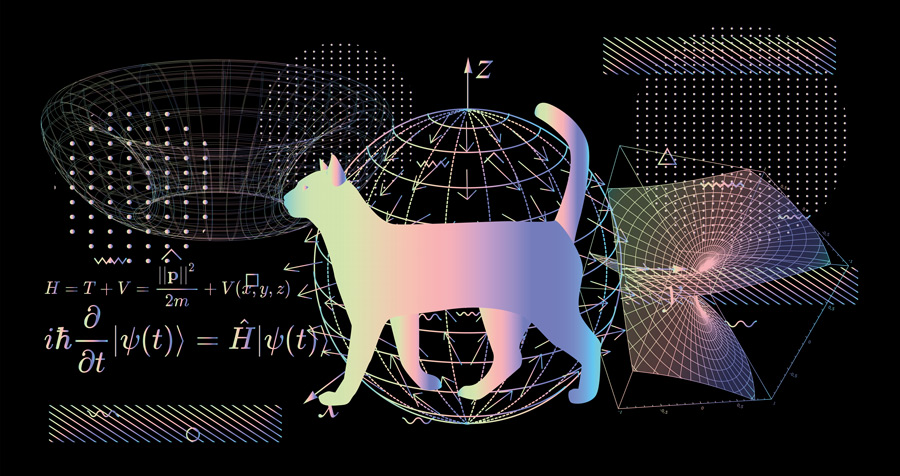
Schrödinger’s cat illustrates the problem of applying quantum superposition to everyday objects. The thought experiment was designed to expose the conceptual difficulties of quantum measurement.
Schrödinger introduced the example to illustrate the difficulty of applying quantum descriptions to everyday objects.
It was not intended as evidence that real cats can be observed in such states.
Modern physics uses a process called decoherence to explain why interference between different macroscopic outcomes becomes extraordinarily difficult to detect.
However, decoherence does not, by itself, settle every question about quantum measurement.
The thought experiment therefore remains an important illustration of the quantum measurement problem.
8. Quantum mechanics in everyday life
Although quantum mechanics may seem abstract, we use technology based on it every day.
Semiconductors and computers
The behaviour of electrons in semiconductor materials is explained using quantum mechanics. This knowledge is essential to the transistors and microprocessors used in modern computers and smartphones.
Solar cells
When photons from sunlight are absorbed in a semiconductor, they can generate mobile electrons and holes. The structure of the solar cell separates these charge carriers, allowing electrical power to be delivered to an external circuit.
LED lighting
Light-emitting diodes produce light when electrons and holes recombine in a semiconductor. The energy released determines the colour of the light.
Lasers
Lasers use stimulated emission to generate controlled light. They are used in telecommunications, industry, medicine and scientific instruments.
Atomic clocks
Atomic clocks use precisely defined atomic transitions to measure time with exceptional accuracy. They are essential for technologies such as satellite navigation.
Quantum mechanics is therefore not simply an abstract theory.
It is fundamental to much of the technology that supports modern society.
9. Quantum computing – a new approach to information
Quantum computers use quantum bits, known as qubits, instead of conventional bits.
By exploiting superposition, entanglement and interference, quantum algorithms can process information in ways that differ fundamentally from classical computing.
For certain problems, this may provide major computational advantages.
However, quantum computers do not simply calculate every possible answer simultaneously and then reveal the correct one.
The challenge is to design algorithms in which quantum interference increases the probability of obtaining useful results.
Quantum computers also face practical difficulties, particularly noise, errors and maintaining quantum coherence.
For more information, see my article on Quantum Computing.
10. Does quantum mechanics imply parallel universes?
Quantum mechanics is extraordinarily successful at predicting measurement results.
But physicists continue to debate what happens during measurement and what the wavefunction actually represents.
One interpretation involves the collapse of the wavefunction.
Another, proposed by Hugh Everett III in 1957, suggests that the universal quantum state always evolves without collapse.
This is the foundation of the Many-Worlds Interpretation.
According to this interpretation, different measurement outcomes correspond to different branches of the universal quantum state.
Does this mean that countless parallel universes physically exist?
Or does the mathematics describe possibilities without necessarily requiring multiple physical worlds?
These remain questions of interpretation.
I discuss them in more detail in my article:
Does Quantum Mechanics Really Mean That Parallel Universes Exist?
11. My personal interest in quantum mechanics
My interest in physics began many years ago and eventually led me towards astrophysics, solar physics and mathematical modelling.
In the early 1980s, I attended introductory courses in quantum mechanics at the University of Oslo.
Although much of my professional career later involved information technology, software development and IT architecture, my interest in fundamental physics has never disappeared.
What continues to fascinate me is the contrast between the extraordinary predictive accuracy of quantum mechanics and the unresolved questions surrounding its interpretation.
We can use quantum theory to design electronics, develop lasers and build increasingly sophisticated quantum computers.
Yet we still disagree about what its mathematics tells us about the underlying nature of reality.
For me, that is one of the most fascinating aspects of modern physics.
We understand an extraordinary amount about how nature behaves, but we are still discovering what that behaviour means.