I’ve been reading a fascinating new research report from Anthropic, and it’s been causing me to rethink everything I assumed about AI and the future of jobs. We’ve all heard the big, sweeping predictions—robots taking over entire professions, mass unemployment, that sort of thing. But this study doesn’t look at the future. It looks at right now.
Anthropic analyzed real-world AI usage across a vast range of job tasks. Instead of asking, “What could AI theoretically do?”—which leads to a lot of wild speculation—they asked, “What is AI actually being used for at work today?” They call this concept “Observed Exposure,” and I think it’s a game-changer for understanding this topic.
The study combines data from over 800 occupations with actual usage patterns from the Anthropic Economic Index. It’s like having a live satellite map of the labor market, rather than an old, hand-drawn map of where we thought the rivers might be. This approach helps create a much clearer picture of which jobs are seeing real, on-the-ground AI adoption.
Looking at the data, I think some very distinct patterns are starting to emerge, and they are not always what I expected.
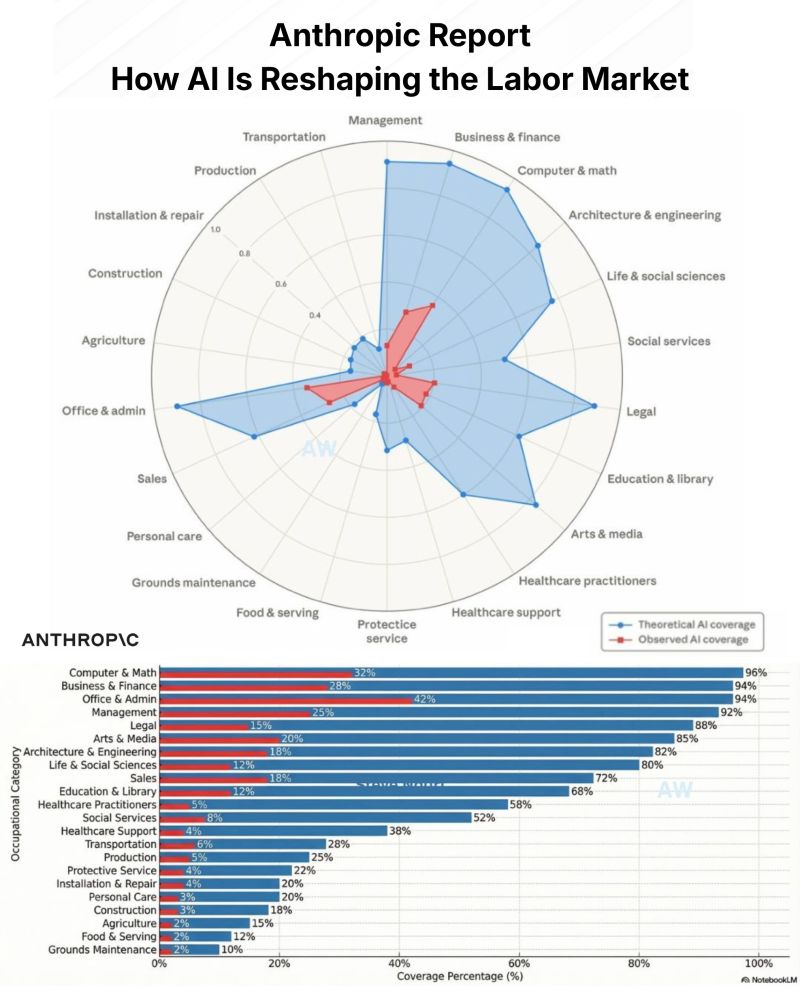
The Gap Between Potential and Reality
The first thing that struck me is how wide the gap is between what AI “can” do and what it “is” doing. The report makes it clear that for many tasks where large language models could be a huge help, they simply aren’t being used in real workflows yet. I think this is a crucial point. We’re still in the very earliest stages of this technology’s integration into the workplace. It’s not that the capability isn’t there; it’s that the habits, the software integrations, and the trust haven’t caught up.
Where the Change is Already Happening
The most exposed roles right now are, unsurprisingly, in the realm of knowledge work. I think about programmers using AI to write or debug code, customer service representatives using it to quickly find answers for frustrated callers, and data entry roles where AI can automate tedious transcription. It makes perfect sense. These are tasks that involve manipulating language and data, which is precisely what today’s AI excels at.
But here is a pattern I found particularly interesting: higher exposure to AI isn’t just hitting low-wage jobs. In fact, the data suggests the opposite. Higher-paid, highly educated roles are also seeing significant AI adoption. These workers—who are more likely to be older, female, and have graduate-level education—are using AI as a powerful assistant. I think this tells us that AI is currently functioning more like a tool for augmentation than a direct replacement. A senior software engineer might use AI to handle boilerplate code, freeing them up for more complex architecture problems. A data analyst might use it to generate initial visualizations.
The Early Signals We Should Watch
So, if people aren’t being massively replaced yet, what *is* happening? The report shows that unemployment signals are still quiet. There’s no clear, sudden spike in joblessness for people in highly exposed occupations. However, I think there is one subtle but significant signal: a hiring slowdown for younger workers.
For people aged 22 to 25, entry into highly exposed roles appears to be declining slightly. I think this is the real story to watch. Companies might not be firing their experienced programmers, but they may be rethinking how many junior programmers they need to hire. If a senior developer can now do the work of 1.5 people with the help of AI, the demand for entry-level positions could shrink. This is where I think the first real impact will be felt, not in a wave of layoffs, but in a slow squeeze on the traditional career on-ramp.
A Positive Conclusion
When I step back and look at the whole picture, I don’t see a reason for despair. Instead, I see a moment of profound, but manageable, transition. AI adoption is happening, but the labor market impact is still in its infancy. The gap between AI’s theoretical capability and its real-world use is still wide open, and that’s where the opportunity lies.
I think the future won’t be about AI simply taking jobs. It will be about AI changing them. The roles that adapt to use these tools effectively will likely become more valuable, more creative, and less bogged down by drudgery. The challenge—and the opportunity—is for us, as a society, to manage how that gap closes. Can we build new on-ramps for younger workers? Can we use this moment to redefine jobs to be more human-centric?
I am cautiously optimistic. The real story is just beginning to unfold, and I believe we have the ability to shape it into a positive one. I’ve included some of the sketches from the Anthropic report that really helped me visualize these concepts. Where do you think AI will change jobs first?